
This week European gas reached its highest price in nearly four years, almost tripling since war with Iran began in February. While the cause this time is the Gulf rather than Russia/Ukraine, this is the same systemic weakness that was first exposed in 2022, when gas set the price of Europe’s electricity 60 per cent of the time while generating only a fifth of it. Europe is still facing its old dilemma: its power is priced by a fuel it does not control and needs to stop buying.
As Italy’s prime minister in 2022, Mario Draghi pushed for a European gas price cap, joint purchasing and a decoupling of electricity prices from gas. The energy crisis following Russia’s invasion of Ukraine made clear that the investment ahead in energy, defence and environmental protection was, he said, too large for any national budget.
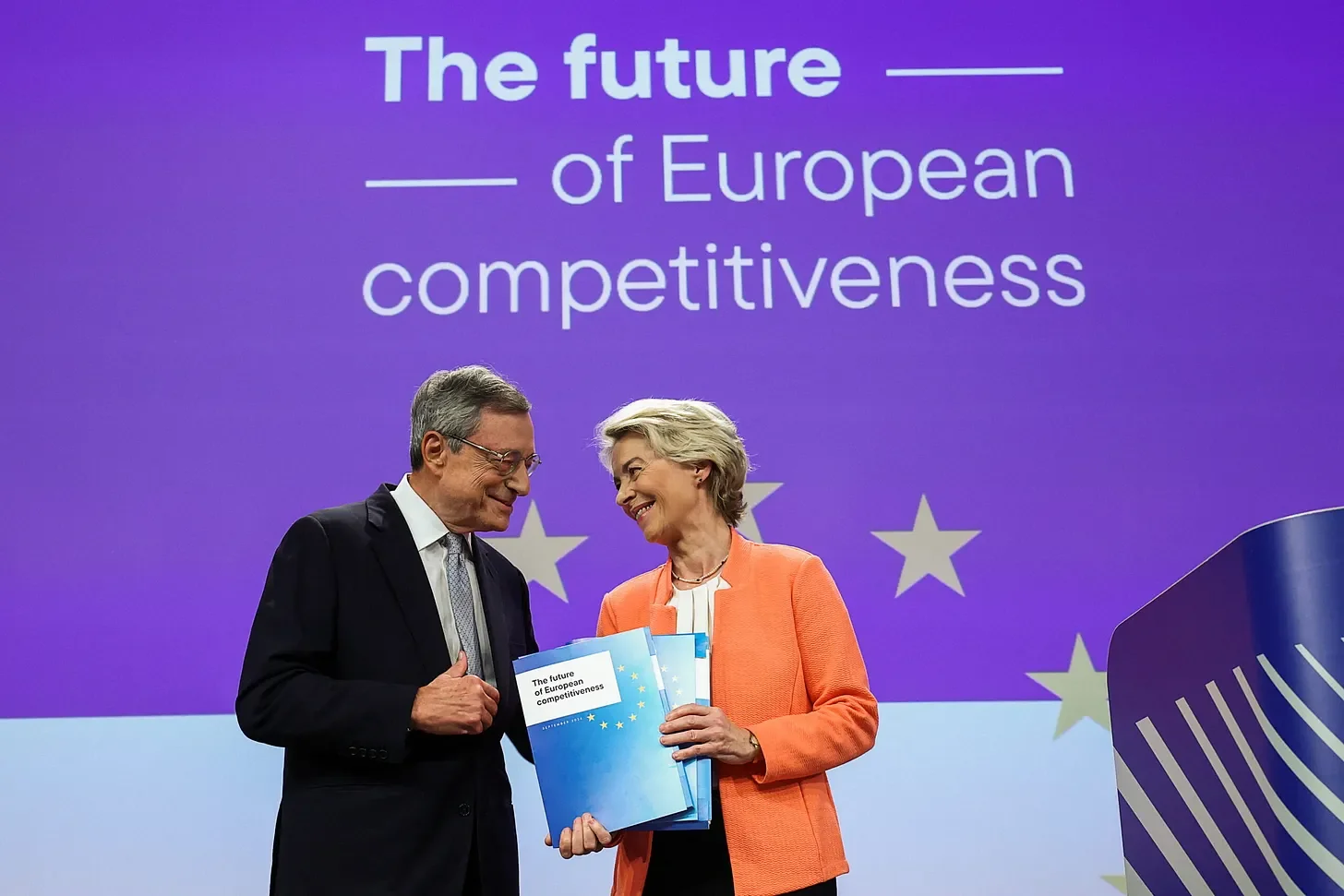
In 2024, as President of the European Central Bank, Draghi pitched power policy in the context of competitiveness in a sprawling report for the European Commission. European companies were paying two to three times American electricity prices. Output in energy-intensive industries such as chemicals, steel and paper had fallen by 10 to 15 per cent since 2021, while imports from cheaper-energy regions rose. Plentiful, cheap clean energy was the answer, but his plan leaned on joint borrowing and centralised energy policy, ideas that fiscally cautious member states such as Germany and the Netherlands would not accept.
In a recent FT op-ed, Draghi turned to data centres. He notes that the EU hosts under 5 per cent of the world’s AI compute, against 75 per cent for the United States, and that the gap between demand and installed capacity, about 3GW today, could reach 14GW by 2030. His concern is sovereignty. Europe cannot match American frontier labs or Asian chipmakers, but it can control its own data, and that means processing it on European soil.
Data centres are the newest energy-intensive industry, and they face the same two obstacles Draghi identified in 2024: expensive power and fragmented money. Building one takes 24 months in the US and 42 in Germany, largely because of permits and grid connections. Investors will only finance capacity against long-term contracts, which American hyperscalers supply and European companies, buying compute a year at a time, do not. As a result, European neoclouds such as Nscale sell most of their capacity to American buyers.
This is a chicken-and-egg problem. Buyers hesitate at current power prices and commit a year at a time, and without long contracts nothing gets built. Draghi’s answer is to aggregate demand by design. ASML, Capgemini and Amadeus have committed to multi-year purchases of compute, intended to underwrite a gigawatt of capacity by 2030. Supply is the grid: renewables, storage and transmission are what make that demand cheap enough to commit to. Cheap power is already within reach in parts of Europe: thanks to cheap renewable power, an AI data centre in Sweden costs only about a tenth more to build than one in China.
This modern grid won’t come cheap. For every euro spent on clean generation through 2040, Draghi’s report estimates, roughly 90 cents of grid investment will be needed, but the report argues that the investment would more than pay for itself, with €6bn a year of investment costs offset by €9bn a year of energy cost savings by 2040. The avoided costs are larger still. European governments spent over half a trillion euros shielding households and businesses from the 2022 price shock, and every megawatt of wind, solar and storage reduces exposure to the next one, whether it comes from Russia or the Gulf. Then there is growth. ECB scenarios cited by Draghi suggest fast AI adoption could add 0.3 to 0.4 percentage points a year to productivity growth, gains that pay for the compute commitments that justify the power behind them. The longer record points the same way: since 1980, electricity’s role in global final energy has grown slightly faster than world GDP, while fossil fuel use has risen only about a fifth as much.
There are good reasons for scepticism. A year after the 2024 report, none of its 83 energy recommendations had been fully delivered, and Draghi himself said the situation had worsened. Credit markets are growing warier of AI borrowers. Economists reasonably ask whether scarce cheap power should go to low-margin heavy industry, and the same question will soon be asked of server farms.
None of this changes the underlying arithmetic. The AI buildout has become a strategic necessity for the United States and China, and Europe’s version has barely begun. A continent that builds a modern grid centred on renewables gets more geopolitical independence, cheaper power, industrial retention and a seat at the table in AI. One that does not gets none of these. Europe has had the diagnosis since 2022. Now it has to put its differences aside and execute on it.
